
What is the window of tolerance? (And why it is the key to recovery)
There are moments when you can handle almost anything. A difficult conversation, a stressful day, disappointing news. You stay present, think clearly and get through it.
And there are other moments when the smallest setback completely overwhelms you. The same situation, but you react as if it is a catastrophe.
That difference has a name: the window of tolerance.
What is the window of tolerance?
The window of tolerance is a concept developed by psychologist Dan Siegel that later became central to somatic therapy and trauma treatment. It describes the zone in which your nervous system functions optimally: you are alert but not overwhelmed, present but not shut down.
Within that window you can think, connect and experience feelings without being swept away by them. You are resilient.
Outside that window, you are not.
What happens above the window of tolerance?
When you go above your window, your nervous system shifts into sympathetic overactivation: the fight-or-flight state. Your heart rate rises, your thoughts race, you react impulsively. You feel rushed, irritable, anxious or panicked.
Many people with chronic stress live structurally at or just above the edge of their window. They still function, but at an enormous cost.
What happens below the window of tolerance?
Less well known but equally significant: the dorsal freeze. Your nervous system shuts down to protect you. You feel numb, empty, apathetic. Making decisions becomes impossible. Emotions feel flat. Social contact asks too much.
This is not laziness. This is an ancient survival mechanism that kicks in when the pressure becomes too great.
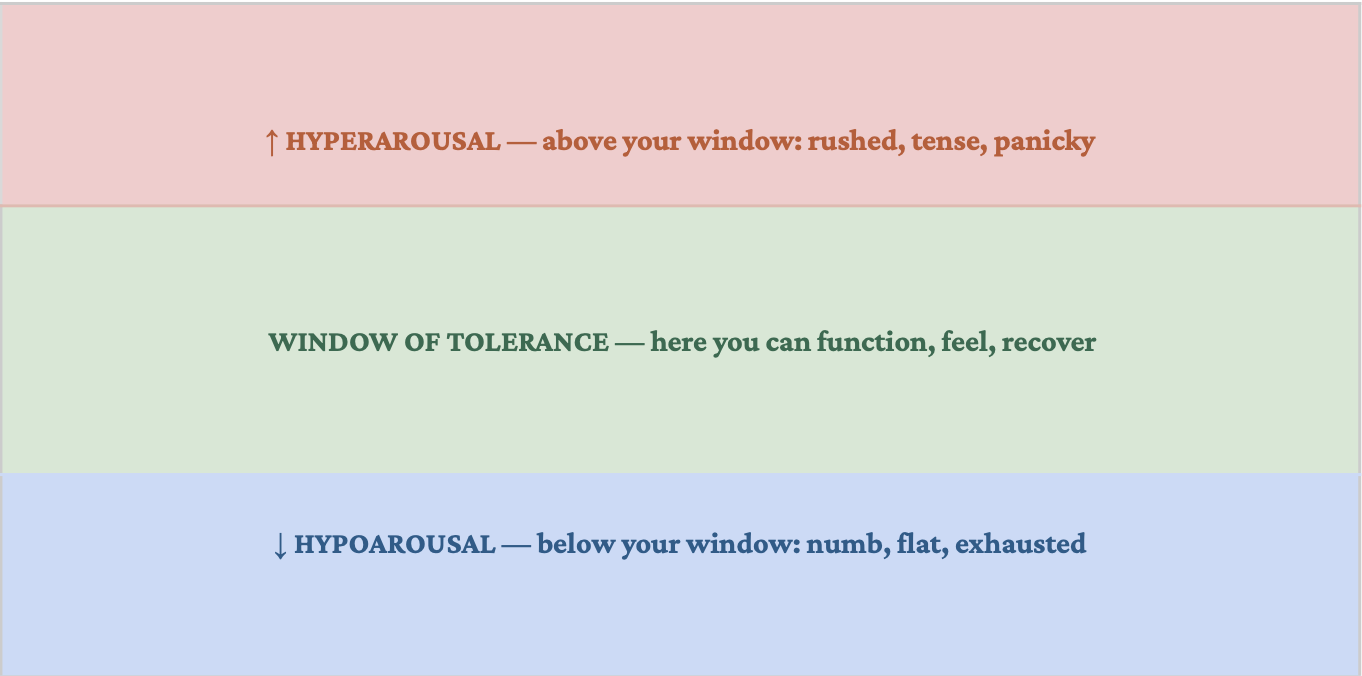
Window of tolerance Dan Siegel
Why is the window narrower in some people than others?
Your window of tolerance is shaped by your life experiences. Early childhood stress, trauma, prolonged overload and an environment that gave little space for recovery all make the window narrower.
The good news: the window can be widened. Not by pushing harder, but by safely practising at its edges. That is exactly what Somatic Experiencing does.
How do you begin?
The first step is learning to recognise where you are. Are you above your window? Below it? Or in it? That awareness, however simple, is the foundation of everything. My Nervous System Guide includes a daily 30-second check-in to practise exactly that.
Going beyond understanding
Want to know where your nervous system stands right now? The free Nervous System Scan gives you a clear picture in just a few minutes.
Want to understand why your nervous system responds the way it does? The Nervous System Guide explains why your nervous system does what it does, and what you can change about it step by step.
Looking for personal guidance? Read more about 1:1 sessions.
